

Product Overview
Whatman 7182-002 WCN Cellulose Nitrate Membrane Filters - 25mm, 0.2µm Pore, Plain White, Non-Sterile, 100 Circles
Condition
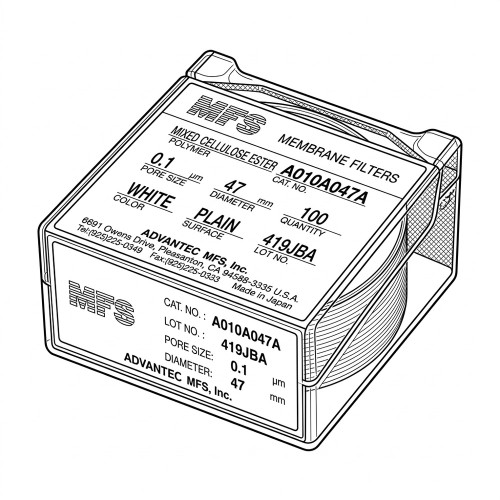
Unused NOS. Package is sealed and unopened in original manufacturer's clear plastic storage box. Label markings confirmed: Cat No 7182-002, cellulose nitrate, white plain, 25 mm diameter, 0.2 µm pore size, WCN type, 100 circles, Made in Japan. Sourced from a government research facility.
Carefully packed and shipped same or next business day from our Idaho warehouse. Online since 1999. Honest equipment and straightforward service.
A no-hassle satisfaction guarantee on every order.
Product Overview
Whatman 7182-002 cellulose nitrate membrane filters - 100 plain white 25 mm circles per sealed pack, 0.2 µm pore size, WCN type, manufactured in Japan. The 0.2 µm pore is the industry standard for sterilizing filtration and complete bacterial retention. Cellulose nitrate offers a highly uniform pore structure and low extractables, making these membranes well suited to both microbiological and gravimetric analytical work. These filters are non-sterile as supplied; autoclave in-house before any sterile application.
Key Features
- Material: Cellulose Nitrate (WCN type)
- Diameter: 25 mm circle
- Pore size: 0.2 µm - standard for sterilizing filtration and bacterial retention
- Surface: Plain white, non-gridded
- Sterility: Non-sterile as supplied; steam autoclavable for sterile use
- Quantity: 100 circles per sealed pack
- Maximum service temperature: 80°C
- Manufacturer: Whatman (now part of Cytiva); Made in Japan
- Catalog number: 7182-002; US reference: 28420734
- Compatible with 25 mm vacuum filtration holders, syringe filter holders, and membrane support bases
Applications
- Microbiologist autoclaves a batch of these 25 mm discs at the start of the week, then loads individual membranes onto vacuum filtration holders to recover and enumerate bacterial colonies from water or pharmaceutical samples
- QC lab technician places a pre-weighed membrane in a vacuum apparatus, passes a liquid sample through to capture suspended solids, dries it, and re-weighs for total suspended solids (TSS) gravimetric analysis
- Analytical chemist uses the membrane's ability to dissolve completely in specific organic solvents (acetone, ethyl acetate) to recover captured particulate matter for downstream characterization without filter matrix interference
- Microbiology researcher filters culture media or biological fluids for mycoplasma removal prior to cell culture work
Frequently Asked Questions
Are these filters sterile?
No. Catalog number 7182-002 is non-sterile as supplied. For sterile filtration or microbial recovery work, autoclave the membranes in-house before use. Sterile, individually packaged variants are available under different Whatman catalog numbers.
Are these compatible with my 25 mm vacuum filtration manifold?
Yes. These are standard 25 mm diameter membrane circles and fit filtration holders, vacuum manifolds, and support bases designed for 25 mm discs.
Can I use these with organic solvent samples?
Depends on the solvent. Cellulose nitrate is incompatible with ketones (acetone), esters, and ether-alcohols - these will swell or dissolve the membrane. For samples containing those solvents, PTFE or Nylon membranes are the appropriate choice. For aqueous samples and mild solvents, these filters are well suited.
Can cellulose nitrate membranes be dry-heat sterilized?
No. Cellulose nitrate (nitrocellulose) is flammable and carries a GHS flame hazard classification. Steam autoclaving is the appropriate sterilization method. Do not expose to dry heat or open flame.
What pore sizes and diameters does Whatman offer for this membrane type?
Alternate pore sizes include 0.1 µm, 0.45 µm, 0.8 µm, 1.0 µm, 3.0 µm, and 5.0 µm. Alternate diameters include 13 mm, 47 mm, 50 mm, and 90 mm. Gridded (colony-counting) surface variants also exist. This listing is for the 25 mm, 0.2 µm plain white format only.
A sealed pack of 100 from a government lab - stored, not forgotten. The pore that set the sterilizing filtration standard hasn't changed, and neither has the work waiting for it.